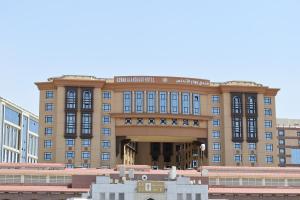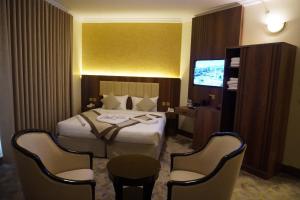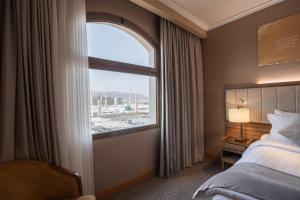

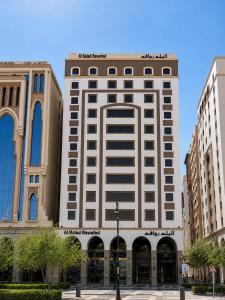
Mysk Al Balad
290 m from Al Masjid an Nabawi · Medina
Airport ShuttleMeetingSafety Deposit Box
9.1Superb3112 reviews
9.1Superb3112 reviews
Select dates to see prices

Your Account
14 Jumada al-Ula 1448 AH·25 Oct 2026·5:43 AM(Madinah time)
Secure Booking Portal
Sacred sites & ziyarat
There are 325 hotels and apartments within 1 km, including hotels, residences, and apartments.
Nearest:Madinah Manazeli Hotel· 240 m
Location
Handy to know
As listed by each hotel.
Quality
Sacred sites & ziyarat
Masjid an-Nabawi is the Prophet’s Mosque in Madinah, a major place of prayer and ziyarat. The Rawdah is inside the mosque, between the house of the Prophet ﷺ and the minbar. Ordinary salah and Rawdah access have different arrangements.
A Rawdah visit requires a Nusuk permit and an available time; visits for men and women have separate slots, with an instant-access booking option when offered near the mosque. Women’s prayer halls are separate; the Ministry guide names gates 13–17D for the western hall and 23–31b for the northern hall. Visitor guidance asks worshippers to wear their best clothing, keep calm, and avoid crowding. Expect higher visitor density during holiday periods and peak prayer times.
At the mosque, use numbered gate signs and follow the designated route for your prayer area. Wheelchairs are available at Al-Salam, Siddiq, Al-Rahmah, Bab al-Baqeei, Bab Al-Janazat, Bab Al-Hijrah, and Bab Quba; mosque services also include lifts and ramps. MED is about 20 km from the mosque. Madinah Bus Route 400 links the airport with the mosque and central area; taxis are another option. The municipal bus map shows a Haramain Express station stop along the airport–mosque service.
325 hotels and apartments are within 1 km of Masjid an-Nabawi; 91 are within 0.5 km. The mix includes 268 hotels, 17 apartments, 11 residences, and 3 aparthotels, plus one inn, one villa, one chalet, and 23 entries without a property type shown. Compare distances and available property details when choosing a place to stay. The pedestrian route to a courtyard gate varies by the property’s location and the access in use.
Facts reviewed against the sources above on 19 October 2026. Hotel numbers come from the hotels listed on this page.
Masjid an-Nabawi has grown through successive building works, from the first mosque built by the Prophet ﷺ to the present-day expansions and courtyards.
The Prophet ﷺ began building the mosque in Rabi al-Awwal on a date-drying ground belonging to Sahl and Suhayl, two orphans; he laid its first foundation stone and worked alongside the Companions (may Allah be pleased with them). It was finished in Shawwal (April 623 CE). The first mosque had a stone foundation, mud-brick walls, palm-trunk columns and a palm-frond roof over the qibla side. It had three doors; after the qibla turned towards the Kaaba, the south door was closed and a north door opened.
After the return from Khaybar, the mosque was enlarged on every side except the qibla side, reaching a square of about 100 by 100 cubits, roughly 2,433 square metres. Its walls were about 74 centimetres thick and 3.45 metres high.
Sayyiduna Umar ibn al-Khattab (may Allah be pleased with him) enlarged the mosque west, south and north after buying surrounding houses; the rooms of the Prophet's ﷺ wives (may Allah be pleased with them) stood to the east. The mosque reached 140 by 120 cubits, about 4,088 square metres, and its roof stood about 5.4 metres high. Small stones from Wadi al-Aqiq covered the floor, and six doors stood two each in the north, east and west walls.
Sayyiduna Uthman ibn Affan (may Allah be pleased with him) rebuilt and enlarged the mosque from Rabi al-Awwal 29 AH to Muharram 30 AH, using 10,000 dirhams of his own money. It reached about 170 by 130 cubits, roughly 5,378 square metres, with walls of hewn stone and lime plaster, carved-stone columns reinforced with iron rods set in lead, and a teak roof. The six doors remained.
The Umayyad government enlarged the mosque under its governor of Madinah, Umar ibn Abd al-Aziz (may Allah have mercy on him), between 706 and 709 CE, buying surrounding houses and incorporating the chambers of the Prophet's ﷺ wives (may Allah be pleased with them), including the chamber where the Prophet ﷺ is buried. Cut-stone walls, four corner minarets and the first hollow mihrab were added; the increase is estimated at about 2,369 square metres. Salih ibn Kaysan (may Allah have mercy on him) supervised the work, recorded in an inscription when it ended in 91 AH (710 CE). A report says the Umayyad government requested skilled craftsmen from the Byzantine emperor and received gold, forty loads of mosaic and a hundred craftsmen; scholars think some materials may have gone to the Umayyad Mosque in Damascus.
After a pilgrimage visit to Madinah in 160 AH, the Abbasid government ordered an extension northward, carried out between 161 or 162 AH and 165 AH. The mosque reached about 9,309 square metres and had 290 columns. Marble faced the lower qibla wall, while gold pieces on its upper part looked like mosaic from a distance. Accounts differ on the number of doors afterwards: the Madinah Encyclopedia gives 24, while other accounts give 20 or 19.
A fire badly damaged the mosque on 1 Ramadan 654 AH (22 September 1256 CE). The last Abbasid caliph sent materials, but the fall of Baghdad stopped the work before Mamluk sultans took it up. The front section, with four main gates, was finished in 1259-60 CE; the full rebuilding was completed in 668 AH (1269-70 CE). In Mamluk times, most older doors were closed, leaving Bab Jibril, Bab al-Nisa, Bab al-Salam and Bab al-Rahmah as the four main doors.
Lightning struck the south-east minaret on 13 Ramadan 886 AH (5 November 1481 CE), and the fire that followed destroyed two roofs, the pulpit and the enclosure around the Prophet's ﷺ chamber, while damaging most columns. Mamluk Sultan Qaitbay (may Allah have mercy on him) of Egypt sent workers and materials; renovation and decoration finished in 888 AH (1483 CE), with finishing work continuing to 890 AH. The mosque reached about 9,429 square metres, with a larger dome over the Prophet's ﷺ chamber and two domes on the Bab al-Salam side. A madrasa and ribat were built between Bab al-Salam and Bab al-Rahmah.
Under Ottoman Sultan Suleiman the Magnificent (may Allah have mercy on him), engineers and craftsmen sent from Istanbul repaired the mosque between 938 and 947 AH. The Ottoman rebuilding gave the mosque the Majidiyya minaret in the north-west, the Bab al-Salam minaret in the south-west and the Bab al-Rahmah minaret in the west. The Bab al-Salam minaret goes back to one built by Muhammad ibn Qalawun (may Allah have mercy on him) in 706 AH (1306-07 CE).
Sultan Mahmud II (may Allah have mercy on him) had a new stone dome built over the Prophet's ﷺ chamber, covered it in lead and painted it green; it is the Green Dome known today.
Ottoman Sultan Abdulmejid I (may Allah have mercy on him) decided to rebuild the mosque in late 1849, after Davud Pasha (may Allah have mercy on him), the shaykh of the Haram, wrote that it had not been fully restored for about four centuries. Abdulhalim Efendi (may Allah have mercy on him) led the building commission before his death in Makkah that year; Mehmed Raif Pasha (may Allah have mercy on him) then took over. Building ran from 1267 AH (1851 CE) until 1277 AH (1861 CE), about twelve to thirteen years. The rebuilt mosque measured about 10,939 square metres, with a marble floor, 327 columns, black-basalt walls and domes replacing the wooden roof. Its five renewed gates were Bab al-Salam, Bab al-Rahmah, Bab al-Nisa, Bab Jibril and the new Bab al-Majidi. Calligrapher Abdullah Zuhdi (may Allah have mercy on him) spent three years writing gilded thuluth inscriptions across the mosque. North of the arcades, the sultan added Quran schools and storerooms.
King Abdulaziz (may Allah have mercy on him) announced the first Saudi expansion in 1368 AH (1949 CE); demolition began in 1370 AH, and the work was completed under King Saud (may Allah have mercy on him) in 1375 AH (1955 CE). The expansion went north, east and west while keeping the southern part of the Ottoman building. It added more than 6,000 square metres and brought the mosque to about 16,300 square metres, with two courtyards divided by a portico. Reinforced-concrete columns carried pointed arches; 232 round columns had bronze capitals and a timber ceiling decorated with plant motifs. Two 72-metre minarets brought the total to four, and the doors rose to ten. The expansion kept earlier gates and added Bab King Abdulaziz, Bab King Saud, Bab Uthman, Bab Umar and Bab al-Siddiq.
Under King Faisal (may Allah have mercy on him), land west of the mosque was cleared and shaded as a 35,000-square-metre prayer area in 1395 AH (1975 CE); 5,550 square metres were added later, bringing it to about 40,550 square metres. Under King Khalid (may Allah have mercy on him), a further 43,000 square metres were cleared and shaded as a courtyard in 1397 AH (1977 CE), after a fire in the Souq al-Qumasha market to the south-west.
King Fahd bin Abdulaziz (may Allah have mercy on him) laid the foundation stone of the second Saudi expansion on 2 November 1984 (1405 AH); it was completed in 1414 AH (1993-94 CE). The new 82,000-square-metre building surrounded the older mosque to the north, east and west, bringing the mosque itself to about 98,500 square metres. With courtyards, capacity passed 650,000 worshippers and reached up to one million at peak times. The ground floor has 2,028 marble-clad columns with copper crowns, and 27 sliding domes, each 18 metres across. Six new minarets of about 104 to 105 metres brought the total to ten. The expansion incorporated Bab Umar, Bab Uthman, Bab al-Majidi, and the gates of King Abdulaziz and King Saud. Its seven principal entrances have five adjoining doors each, and 41 numbered entrances were recorded.
King Abdullah (may Allah have mercy on him) laid the foundation stone of the third Saudi expansion on 24 September 2012 (1433 AH); Custodian of the Two Holy Mosques King Salman ordered it completed. The planned area is 1,020,500 square metres, including roofed buildings and courtyards, and capacity rises to around 1.8 million worshippers. The expansion includes 250 umbrellas shading 143,000 square metres of courtyards.
The Ministry of Hajj and Umrah lists 100 gates for the mosque and 40 for its courtyards today.
Pick the gate you plan to use: each page has its verified details, the gates next to it and the hotels closest to it.
FAQ
82 of them list free parking, for example Gewar Alandalus hotel, Al Madina Golden Hotel, New Madina Hotel By IHG.
Madinah Manazeli Hotel, about 240 m away.
The closest options by distance include Zad Al Eman Suites Hotels at 0.1 km, AL ANSAR PLATINUM Hotel at 0.2 km, and Green Tower Hotel at 0.3 km. Actual pedestrian access varies by the route and the gate you need.
Within 1 km, the mix includes 268 hotels, 17 apartments, 11 residences, and 3 aparthotels, plus one inn, one villa, one chalet, and 23 entries without a property type shown.
MED is about 20 km from the mosque. Madinah Bus Route 400 connects the airport with the mosque and central area, and taxis are also an option. The municipal map shows a Haramain Express station stop on the bus service.
A separate Nusuk permit and an available appointment are required for Rawdah access.
Rawdah visits have separate time slots for men and women. Choose from the times currently available through Nusuk; an instant-access option is offered to visitors near the mosque.
Official visitor guidance asks worshippers to wear their best clothing and to respect the mosque’s designated prayer areas. Women have separate prayer halls, with access through the gates identified in the Ministry’s visitor guide.
Official mosque guidance lists wheelchair availability at several named gates, along with lifts, ramps, prayer chairs, and mobility vehicles. Ask mosque staff for help choosing an accessible entrance for the prayer area you plan to use.
No. We charge no booking fees. Hotel taxes and any charges set by the property are separate.
Plan your trip